
Click to view
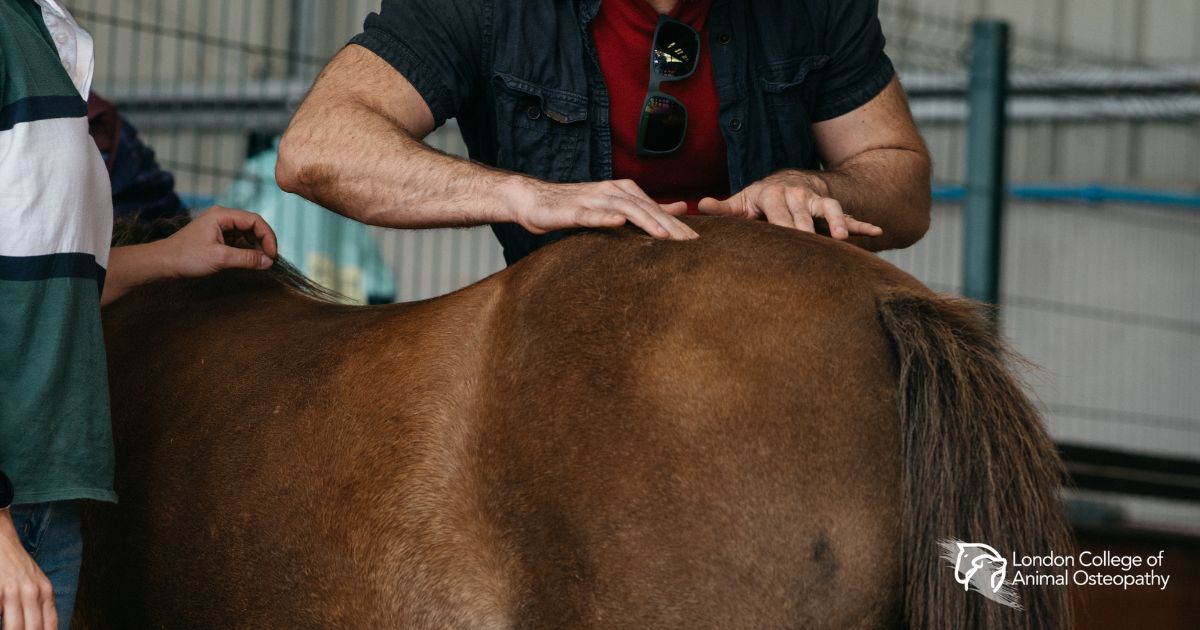
Riders and trainers have written about the one-sided horse for centuries. Some horses find it easier to the left; others resist collection on the right. The conventional explanation — natural laterality, a dominant side, brain hemisphere preference — has gone largely unchallenged in equestrian literature. Leslie-Anne Kennedy's thesis challenges it directly. The argument Kennedy develops is that what riders interpret as natural crookedness may in many cases be the observable consequence of Type 1 or Type 2 osteopathic spinal lesion patterns — functional dysfunctions identifiable through systematic assessment, and addressable through osteopathic treatment. This is not a theoretical exercise. Kennedy applies Fryette's three laws of spinal motion — the foundational framework for understanding how vertebral segments move and restrict — to specific performance difficulties in elite dressage, using the counter change of hand in canter as her central example. The analysis is forensic. In a Type 1 scoliosis lesion pattern, where sidebending has become fixed in one direction, Kennedy traces how the imbalance cascades through the flying change, the half pass, and the quality of the canter strike-off. The horse is not being difficult. Its spine has a structural reason for what it can and cannot do in each direction. A case study of a performance mare brings the theory into sharp focus. A combination of occiput-atlas restriction, coxo-femoral dysfunction, gluteal reactivity, and a subtle proprioceptive deficit pointed clearly to a Type 2 lesion pattern. The mare's gait, her resistance on the left rein, her asymmetric footfall — all of it mapped coherently onto the osteopathic findings. Osteopathic Articular Balancing produced measurable positive results. The thesis raises a question that should give every rider pause: when a horse resists a movement, how often do we ask whether it physically can, rather than whether it will? Kennedy's answer, backed by assessment protocols and case evidence, makes a compelling argument for osteopathic evaluation as standard practice in performance horse management.



.jpg)




.png)


.png)
.png)
