

Navicular syndrome remains one of the most challenging and emotionally draining diagnoses in equine medicine. For decades, it has frustrated veterinarians, farriers, therapists, and owners alike — not because it is rare, but because it is complex, progressive, and rarely simple to manage well.
Traditionally, navicular disease treatment focused on pain control and corrective shoeing. While those remain essential, modern understanding has moved well beyond a single-structure model of disease. What we now call navicular syndrome is more accurately understood as a form of caudal heel pain syndrome — a condition involving multiple tissues, biomechanical forces, and compensatory patterns throughout the horse’s body.
Emerging clinical evidence and practical experience both point toward the same conclusion: sustainable management requires more than symptom control. It requires a coordinated, whole-horse approach that integrates veterinary care, farriery, and appropriate supportive therapies.
Understanding Navicular Syndrome: More Than Just a Bone Problem
The navicular bone sits deep within the hoof, positioned between the deep digital flexor tendon (DDFT) and the coffin joint. It plays a crucial biomechanical role in force transmission, shock absorption, and movement efficiency.
However, navicular syndrome in horses is no longer viewed as isolated navicular bone degeneration. Instead, it is understood as a multifactorial condition involving a network of interconnected structures, including:
- Navicular bone remodeling and surface changes
- Deep digital flexor tendon inflammation, degeneration, or adhesions
- Navicular bursa inflammation
- Collateral sesamoidean ligament strain
- Impar ligament pathology
- Coffin joint involvement
- Altered vascular perfusion in some cases (the exact role of vascular factors remains debated)
For many horses, the disease develops gradually. Lameness is often subtle at first — intermittent, inconsistent, and easily dismissed as stiffness or training-related soreness. Over time, discomfort becomes more persistent, particularly on hard or uneven surfaces.
What makes navicular syndrome especially challenging is not just the local pathology, but the way the horse adapts. As pain develops in the caudal heel region, movement patterns change. These compensations don’t stay in the foot — they ripple through the limb, the back, and the entire musculoskeletal system.

Traditional Navicular Disease Treatment: The Foundation
Despite advances in integrative care, conventional veterinary management and corrective farriery remain the non-negotiable foundation of navicular treatment.
Veterinary Medical Management
Standard veterinary approaches typically include:
- NSAIDs as first-line pharmaceutical support to control pain and inflammation. The careful management of pain is critical, as uncontrolled discomfort leads to further biomechanical compensation and accelerated deterioration.
- Bisphosphonates (such as tiludronate and clodronate) in selected cases, where osseous pathology is evident and pain modulation is required
- Intrasynovial or intra-articular injections of corticosteroids and/or hyaluronic acid when coffin joint or navicular bursa involvement is confirmed
Historically, vasodilators such as isoxsuprine were widely used, though evidence for their effectiveness has been inconsistent and they are now less commonly relied upon in modern protocols.
Medical management plays a vital role, but it is not a cure. Its purpose is to reduce pain, slow progression where possible, and support function — not to reverse established pathology.
The Critical Role of Farriery
Corrective farriery remains the cornerstone of navicular management. The goal is biomechanical: reduce stress on the navicular region, improve breakover, optimise loading patterns, and support healthy hoof function.
Just as proper hoof care and osteopathic principles work synergistically, understanding the biomechanical implications of farriery choices helps inform the broader therapeutic strategy.
Common strategies include:
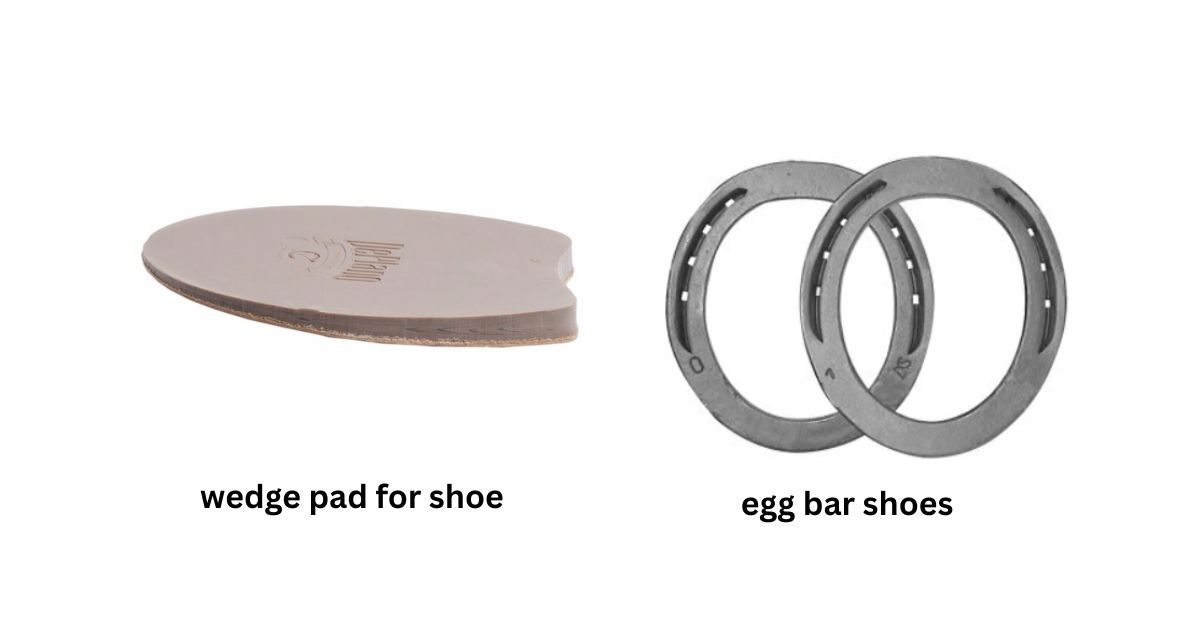
- Egg bar or heart bar shoes for heel support and load redistribution
- Wedge pads or raised heels to reduce DDFT tension
- Rolled or rockered toes to ease breakover
- Wide-web shoes for increased support
- Carefully managed barefoot protocols in select, appropriate cases
Effective navicular management requires active collaboration between vet and farrier, with regular reassessment and adjustment as the horse’s response evolves.
The Biomechanical Cascade: Why Navicular Syndrome Affects the Whole Horse
A horse with caudal heel pain doesn’t just have a sore foot — it has a changed movement strategy.
To avoid discomfort, the horse alters stride length, loading patterns, and limb timing. These adaptations create secondary stress throughout the musculoskeletal system:
- Altered loading travels up the limb, affecting joints, tendons, and ligaments
- Asymmetry develops between limbs
- Diagonal loading patterns increase strain on compensating limbs
- Back muscles adapt to uneven propulsion
- Thoracolumbar and cervical tension patterns develop
Over time, these compensations can become sources of pain in their own right. Back soreness, pelvic tension, neck stiffness, and secondary limb issues are not "separate problems" — they are often downstream effects of the primary pathology.
This is why treating only the foot often produces incomplete results.
Beyond Traditional Treatment: Integrating Complementary Approaches
Conventional treatment remains essential. But addressing the secondary biomechanical consequences of navicular pain can significantly influence long-term comfort and function.
The Role of Manual Therapy in Navicular Management
Manual therapy, including osteopathy, can play a supportive role when used appropriately and ethically within a veterinary-led plan.
It does not treat the navicular pathology itself. It addresses the compensatory patterns created by it.
For navicular horses, osteopathic assessment commonly focuses on:
- Thoracolumbar restrictions
- Sacroiliac and pelvic asymmetry
- Shoulder and cervical loading patterns
- Myofascial restrictions
- Global postural balance
The goal is not cure — it is functional efficiency. By reducing compensatory strain, the horse can move more comfortably within its physical limitations.
Manual therapy should always:
- Be coordinated with veterinary care
- Support, not replace, medical management
- Work alongside farriery strategies
- Respect inflammatory and pathological boundaries
Therapeutic Exercise and Rehabilitation
Complete rest is rarely beneficial long-term. Thoughtfully structured movement supports circulation, tissue health, muscle conditioning, and joint function.
A sensible rehabilitation approach may include:
- Controlled hand-walking on appropriate surfaces
- Managed turnout
- Gradual, progressive strengthening work
- Balance and proprioceptive training
- Low-impact conditioning modalities where available
Movement is not about workload — it’s about quality, control, and consistency.
Nutritional and Metabolic Considerations
Body condition matters. Excess weight increases loading forces through the caudal heel and accelerates mechanical strain.
While equine metabolic syndrome (EMS) is not directly causative in navicular disease, systemic inflammation, insulin dysregulation, and obesity can negatively influence tissue health, recovery capacity, and overall biomechanics.
Good management focuses on:
- Maintaining optimal body condition
- Supporting metabolic health
- Preventing secondary conditions such as laminitis
- Managing inflammatory load through nutrition
The Interdisciplinary Team Approach
Successful navicular management is never the result of a single intervention.
It depends on coordinated care between:
- Veterinarian: diagnosis, imaging, medical management, monitoring
- Farrier: biomechanical correction and hoof support
- Manual therapist: management of compensatory dysfunction
- Rehabilitation specialist: structured movement planning
- Owner: daily consistency, observation, and care
No single role is more important than the others — but none can replace the foundation of veterinary diagnosis and farriery.

When to Integrate Osteopathic Care
Osteopathic care may be appropriate when:
- Compensatory gait patterns persist despite medical management
- Secondary back, neck, or limb pain develops
- Performance plateaus despite correct farriery and veterinary care
- The veterinary team recommends supportive manual therapy
- Long-term maintenance of comfort is a goal
It is not appropriate when:
- The horse is in acute pain crisis
- Veterinary diagnosis has not been established
- It is used as a substitute for medical treatment
- Active inflammation requires rest and medical care
The guiding principle is simple: manual therapy supports management — it never replaces it.
The Classical Osteopathy Perspective on Navicular Care
Classical structural osteopathy, emphasises the interconnectedness of structure and function throughout the horse's body. This philosophy aligns particularly well with the modern understanding of navicular syndrome as a condition with whole-body biomechanical implications.
From an osteopathic perspective, the navicular horse doesn't exist in isolation—it functions as part of an integrated system. When pathology develops in the navicular region, the body's natural compensatory mechanisms create a cascade of adaptations that, while initially protective, eventually become dysfunctional themselves.
Osteopathic assessment for navicular horses extends beyond the symptomatic limb to evaluate:
- Pelvic symmetry and sacroiliac function
- Thoracolumbar mobility and any restrictions
- Cervical function and poll mobility
- Forelimb and hindlimb loading patterns
- Fascial continuity throughout the body
- Overall postural balance and movement quality
This comprehensive assessment helps identify not only the primary pathology but the entire pattern of adaptation the horse has developed. Treatment then addresses both the compensatory restrictions and works to optimise the body's inherent capacity for adaptation and healing.
Prognosis and Long-Term Management
Navicular syndrome is a progressive, degenerative condition. There is no cure.
What is possible is management.
Many horses maintain comfort and quality of life for years with appropriate care. Some remain in modified work. Others require lifestyle changes and workload adjustments. Outcomes vary widely.
Prognosis depends on:
- Stage of disease at diagnosis
- Quality of management
- Consistency of care
- Owner commitment
- Individual biological variation
Honest conversations about expectations, limitations, and welfare are essential.
Conclusion: A Comprehensive Approach to Navicular Care
Navicular syndrome is not just a foot problem. It is a whole-horse condition with whole-body consequences.
Veterinary care and farriery remain the foundation. But long-term success often depends on recognising and managing the biomechanical, postural, and compensatory effects that develop alongside the primary pathology.
When professionals work together — vet, farrier, therapist, and owner — care becomes clearer, more ethical, and more effective.
Not because navicular disease can be cured.
But because horses deserve management that is intelligent, coordinated, and compassionate.
FAQs
What is navicular syndrome in horses?
Navicular syndrome refers to chronic pain in the caudal heel region involving the navicular bone and surrounding soft tissues.
Is navicular syndrome the same as caudal heel pain?
Caudal heel pain describes the clinical presentation. Navicular syndrome describes the anatomical structures involved.
Can horses with navicular syndrome stay in work?
Some horses can remain in modified work with appropriate management, veterinary care, farriery, and monitoring. Outcomes vary by case.


.jpg)

.png)


.png)
.png)
