

Click to view
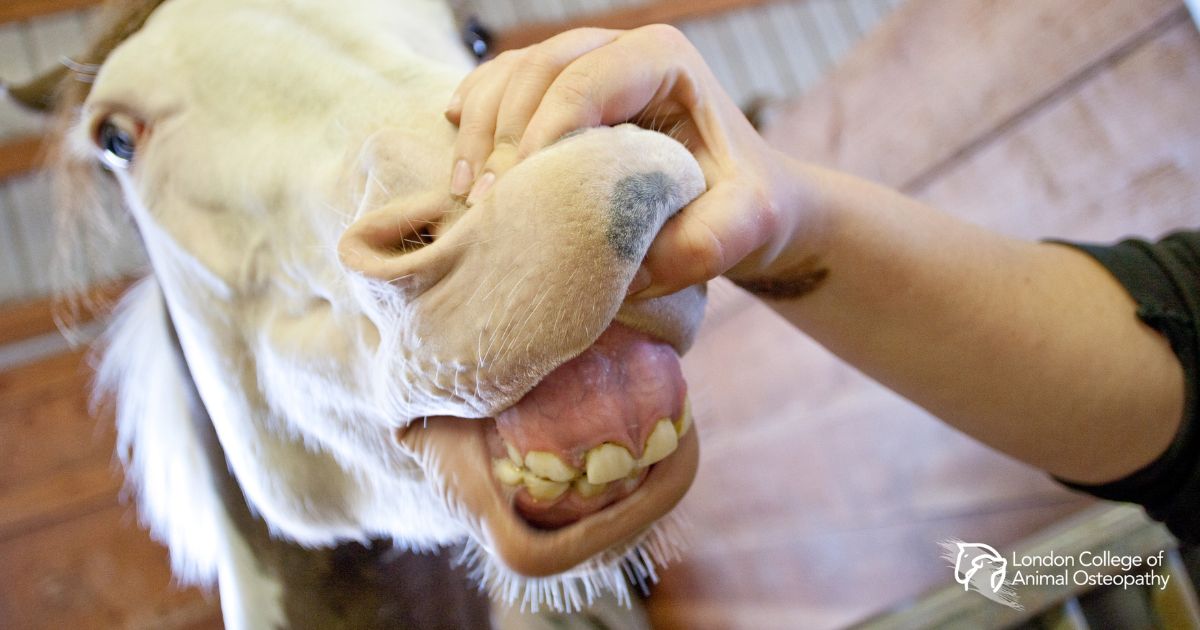
Statistics about equine dental disease are striking. A 1994 survey of 500 equine skulls found evidence of dental disease in 80% of subjects. By 2012, a UK study identified dental irregularities in 95.4% of horses aged fifteen and over — yet only a quarter of owners were aware their horse had a problem requiring attention. Despite decades of routine dentistry, these numbers have barely shifted. Christina Hall, writing for the London College of Animal Osteopathy, asks a provocative question: could the way we approach equine dentistry be part of the problem? Hall, who practises as both an equine osteopath and a qualified equine dentist in the United States, brings a rare dual perspective to this thesis. Her central argument is that modern equine dentistry operates almost exclusively within an allopathic framework — addressing the visible signs of dental abnormality, from hooks and ramps to ulcerations and malocclusions, without asking why those abnormalities exist in the first place. She contends that the answer almost always lies in immobility somewhere in the body, and that osteopathic assessment is the tool best placed to find it. The thesis draws on A.T. Still's four principles of osteopathy to reframe every aspect of dental care. If a horse presents with recurring tongue ulceration, for instance, the standard response is to file the offending tooth surface. But Hall argues the cause is likely restriction at the temporomandibular joint — and that restriction, in turn, may originate in a hoof imbalance, a visceral restriction, or a fascial tension pattern running from the hind limb to the skull. The concept of the 'six legs' — the three paired extremities of mandible, forelimbs, and hindlimbs that govern mobility patterns across the horse's entire body — is introduced as a clinical lens for understanding how restriction in one region cascades throughout the whole. Hall reserves particular concern for routine dental practices such as prolonged speculum use and head positioning on extended dental stands, arguing that these techniques place the upper cervical spine into hyperextension and impose excessive strain on the apical ligament and the temporomandibular joint disc. With nine of twelve equine myofascial kinetic lines originating or terminating at the skull, the downstream consequences of dental procedures performed in biomechanically unsound positions may be far greater than is currently appreciated. This is a thesis that will challenge the assumptions of every equine professional who reads it.
.svg.png)


.jpg)

.png)


.png)
.png)
