

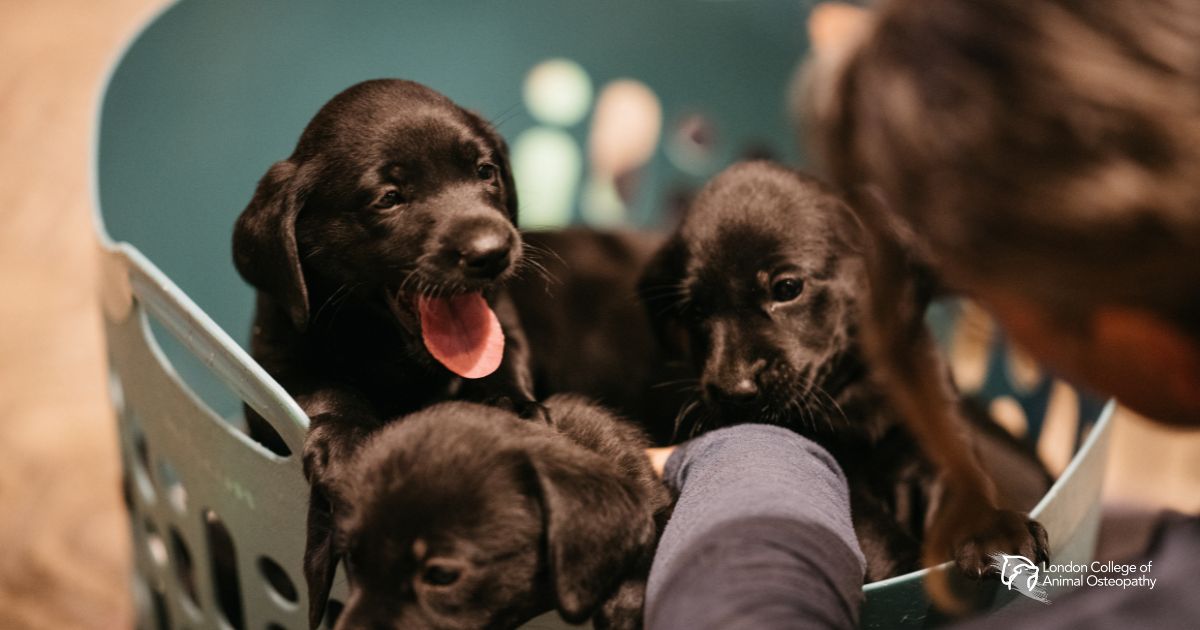
A puppy tumbling across the floor looks the picture of uncomplicated health. They bounce, they stumble, they right themselves and tumble again. And yet, beneath that joyful chaos, something quite remarkable — and quite vulnerable — is happening. The musculoskeletal system of a young dog is not simply a miniature version of the adult. It is an actively changing, highly sensitive structure whose early experiences can leave lasting impressions on how that animal moves, compensates, and ages.
For practitioners trained in classical structural osteopathy, early canine development represents both an opportunity and a responsibility. Understanding what is happening in the young dog's body, and how osteopathic assessment fits into that picture, is knowledge that has real clinical relevance.
The Developing Musculoskeletal System
Canine skeletal development begins in utero, but the growth story continues long after birth. Puppies are born with significant cartilaginous tissue in place of mature bone, and ossification proceeds progressively through the early months and years of life. Growth plates — the physes — remain open until skeletal maturity, which varies considerably by breed. In small breeds, this process may be largely complete by 10 to 12 months. In large breeds this process takes until around 18 months, and in giant breeds up to 24 months — considerably longer than their smaller counterparts
This extended developmental window matters clinically. The growth plates are biomechanically weaker than mature bone, and the surrounding soft tissues. Ligaments, tendons, and joint capsules are still calibrating their tension and elasticity in response to the forces the puppy experiences during normal activity. We know from Wolff's Law that bone changes its density and architecture in response to the mechanical loads placed upon it. Applied to the growing dog, this means the patterns of movement, posture, and loading established early in life are genuinely formative.
Compressive or torsional forces applied repeatedly to an immature joint can alter its trajectory of development. Conversely, varied, appropriate movement on suitable surfaces encourages healthy proprioceptive development and joint congruency.
What Birth Itself Can Do
It is worth pausing on the birth process specifically, because it is rarely discussed in the context of canine development despite its potential significance.
Whelping places considerable compressive and shearing forces on the neonatal body — particularly through the cranium, cervical spine, and thorax. In difficult or protracted births, these forces are amplified. The cranial bones of a newborn puppy are not yet fully fused; they are designed to be somewhat mobile, allowing passage through the birth canal. This same mobility, however, means the cranial structures can sustain strain patterns that persist beyond the birth process itself.
In clinical practice, some experienced animal osteopaths observe that neonates from difficult whelping such as prolonged labour, assisted extraction, and caesarean delivery can present with asymmetric head carriage, difficulty latching, restricted cervical mobility, or altered suckling patterns. These presentations may seem subtle in the first days of life, but they can have downstream effects on the pup's ability to feed efficiently, which in turn affects growth, weight gain, and immune status in those critical early weeks.
Craniosacral approaches, used with great care and extremely light contact appropriate to the neonate, can be employed to assess and address such strain patterns. The work done with foals and calves in this area — including documented cases of neonates presenting with neurological-type symptoms following difficult births that resolved following craniosacral intervention — offers useful analogues for the canine patient.
The Early Weeks: Reflex Patterns and Postural Organisation
In the first two to three weeks of life, a puppy's movement is governed largely by reflexes rather than conscious motor control. The righting reflex, the rooting reflex, and the extensor thrust response all feature prominently. The nervous system is still in rapid development, and the muscular system is building its foundational tone.
During this period, the puppy's primary physical activities are suckling, sleeping, and crawling through the whelping box. The surface they crawl on, the positioning during sleep, and even the way they are handled can influence early musculoskeletal patterning.
Neonates that spend extended time on very slippery surfaces, for example, may develop excessive abduction of the hind limbs. A presentation sometimes described as "swimmers puppy" is when the hindlimbs splay laterally and the pup cannot achieve the normal crawling and standing postures required for healthy hip and stifle joint development. Addressed early with positional support and appropriate surface management, many of these pups recover well. Left unattended, the consequences for joint development can be significant.

Growth Phases and the Osteopathic Assessment
As the puppy moves through the rapid growth phase, broadly from weaning at four to eight weeks through to adolescence, the body is in a state of constant flux. Bones lengthen. Muscles adapt to meet new lever lengths. The nervous system refines its proprioceptive mapping of a body that is literally a different shape week to week.
In terms of canine conditioning, the principles that apply to the adult dog apply in modified form to the developing pup: progressive, appropriate challenge of the musculoskeletal system promotes adaptation and resilience, while overload, whether through excessive exercise, inappropriate surfaces, or inadequate recovery, risks injury to vulnerable growth plates and soft tissues.
An osteopathic assessment during this developmental window is not about looking for gross pathology. It is about evaluating the quality of movement, the symmetry of soft tissue tone, the mobility of spinal segments and peripheral joints, and the overall pattern of how the puppy is organising itself in gravity. Minor asymmetries or areas of restriction found at this stage, before compensatory patterns have had months or years to consolidate, are considerably more amenable to treatment than their adult equivalents.
Practitioners should assess through observation of spontaneous movement before hands-on work. Gait, posture, spinal alignment, and the way the pup loads and unloads its limbs all carry information. Palpation follows — soft tissue texture and tension, articular mobility through gentle passive assessment, and the overall quality of tissue in regions that may be under mechanical stress.
Breed-Specific Developmental Considerations
Not all puppies carry the same developmental risk profile, and this is an area where practitioners benefit from genuine breed literacy.
The relationship between selective breeding and musculoskeletal health in dogs is complex and, in some respects, troubling. Breeds selected for extreme conformational features, such as exaggerated angulation of the hindlimb, foreshortened skulls, and disproportionate body length relative to limb length, carry inherent biomechanical vulnerabilities that are present from birth and worsen as the animal grows. For a deeper look at how these breed-related structural characteristics affect health across the life of the dog, the LCAO article Breed Related Health Difficulties in Dogs provides an overview.
For the osteopath, these breed considerations shape the assessment priorities. A Labrador puppy from working lines has a very different growth trajectory and associated risk profile to a French Bulldog or a Basset Hound. Large and giant breeds, where the bone-to-cartilage ratio takes longest to shift, require particular care around exercise loading during rapid growth phases. Chondrodystrophic breeds — those with genetically short limbs and elongated spines — carry elevated intervertebral disc disease risk that begins accumulating in structural terms from early in life.
Assessing these pups with an understanding of breed-specific anatomy, rather than applying a generic template, is essential to clinically meaningful osteopathic work.
What Osteopathy Can Realistically Contribute
There is an important distinction to draw here between what osteopathic care can offer and what it cannot. Osteopathy does not correct genetic structural abnormalities. It cannot alter the shape of a skull or change the angle of a coxofemoral joint that has developed with inherent laxity. What it can do is work with the secondary and compensatory consequences of those structural realities. In the developing puppy, it can help ensure that the body is given the best possible mechanical environment in which to organise itself as it grows.
Specifically, osteopathic treatment in the young dog may address areas of soft tissue tension that are restricting normal joint mobility, restore appropriate spinal segmental movement in regions that have become restricted following birth strain or an early fall, improve proprioceptive input to the nervous system through gentle articular work, and provide the owner or breeder with practical, evidence-informed guidance on exercise, surfaces, and handling.
The referral relationship with the veterinary team is always central. Osteopathy in the developing puppy sits within a collaborative framework. It is not a standalone intervention but one component of holistic developmental care that may also include veterinary imaging, nutritional guidance, and physiotherapy input where indicated.
Practical Guidance for Breeders and Owners
For breeders in particular, osteopathic assessment of a litter during the early weeks, or at least of any pups from a difficult whelping, represents a genuinely proactive approach to canine welfare. The window of greatest developmental plasticity is also the window of greatest opportunity for low-intervention, high-impact care.
A few principles worth carrying into practice: ensure whelping surfaces provide adequate traction to support normal postural development, as non-slip bedding material in the first weeks has measurable effects on limb position and hip development. Handle neonates frequently, but with care for the spinal axis and with attention to symmetrical rather than asymmetrical positioning. Monitor feeding patterns closely in the first 24 to 48 hours. A pup that is reluctant to latch, or that consistently favours one side, may warrant early assessment. Introduce varied, appropriate physical challenge as the pup grows — different textures underfoot, gentle inclines, social play — without exposing the immature skeleton to repetitive high-impact loading.
And when in doubt, have the animal assessed. The earlier a compensatory pattern is identified, the less work there is to do.
A Clinical Area Worth Taking Seriously
Early canine development is not a niche concern for breeders alone. Any practitioner working with adult dogs presenting with musculoskeletal complaints, asymmetric gait patterns, or chronic soft tissue restrictions is, in some measure, working with the accumulated legacy of that animal's developmental history.
Understanding what happens in the first weeks and months of a dog's life, and what osteopathic care can contribute during that time, deepens clinical practice in ways that benefit animals at every life stage.
Resources
- Marcellin-Little, D.J., Levine, D. and Taylor, R. (2005). Rehabilitation and Conditioning of Sporting Dogs. Veterinary Clinics of North America: Small Animal Practice, 35(6), pp.1427–1439.
- Dueland, R.T., Patricelli, A.J., Adams, W.M., Linn, K.A. and Crump, P.M. (2010). Canine hip dysplasia treated by juvenile pubic symphysiodesis. Part II: two year clinical results. Veterinary and Comparative Orthopaedics and Traumatology, 23(5), pp.318–325.
- Bockstahler, B., Levine, D. and Millis, D. (2004). Essential Facts of Physiotherapy in Dogs and Cats: Rehabilitation and Pain Management. BE VetVerlag.
- Done, S.H., Goody, P.C., Evans, S.A. and Stickland, N.C. (2009). Color Atlas of Veterinary Anatomy: The Dog and Cat. Mosby Elsevier.
- Lewis, G. (2019). Musculoskeletal development of the puppy: Birth to twelve months. Animal Therapy Magazine, Issue 15. Available online via ResearchGate










.png)
.png)
